The Growth of Bowling Greens in England
Urbanization in England proceeded across the period 1600–1800, but accelerated in the first half of the nineteenth century. By 1851 over half the population lived in settlements of 2,500 or more, peaking at around 80 per cent by the 1890s.
The following paragraphs are derived from "Bowled Over: The Bowling Greens of Britain" by Hugh Hornby (Historic England 2015)
Before the mid-19th century, bowls had been fashionable amongst the nobility. Urbanisation broke down old traditions and brought strangers together in new environments. Sports such as football, cricket and bowls helped forge new identities and build communities. Road improvements, together with the coming of the railways, gave ordinary people more of a chance to travel, to pick up new ideas, and to play each other at sport.
Councils began laying down bowling greens and then leased them out. Private bowls clubs grew in number from 1830, as did the number of public house greens. These included greens in public parks, at seaside resorts, and attached to works or institutions, such as Conservative and Liberal Clubs.
The availability of lawn mowers, introduced in the 1830s, followed in the 1890s by the arrival of petrol mowers, no doubt helped in boosting the number of bowling greens being laid. These developments led to some clubs seeking to play their neighbours on a home and away basis.
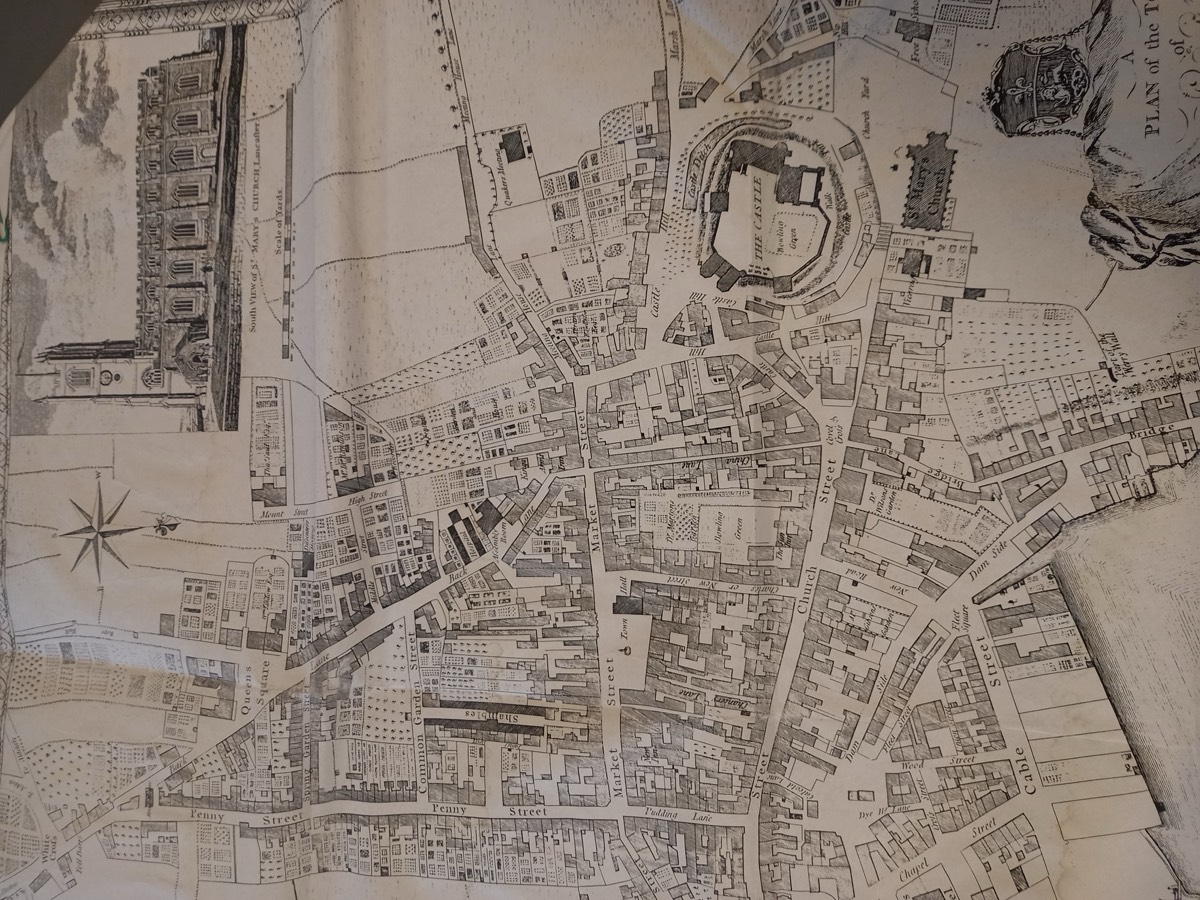
Historic map of Lancaster showing the locations of early bowling greens in the town
Early Bowling Greens in and around Lancaster
The Earliest Known Green
Probably the earliest bowling green in Lancaster can be seen in the 1728 Samuel & Nathaniel Buck copper plate engraving "The North East Prospect of Lancaster". The green is on the Lancaster side of the river, near the river bend. This green would have been in the modern day Waterside area of Lancaster, off Water Street.
The Sun Hotel Green
The bowling green at the Sun Hotel on Church Street was built before 1730. According to Lancaster Civic Society, "Around 1730 the (Marton) family built a Music Room at the bottom of their garden beyond the bowling green. In 1745 New Street was laid out and buildings spread along it, hemming in their garden."
A Historic Move: Hugh Scott (former Secretary of Luneside Bowling Club) discovered through his research that the original green was behind the Sun Inn in the middle of Lancaster. The green was moved to its present position at Luneside because they needed more stable space near the Sun Inn for horses.
Lancaster Castle Green
The bowling green inside Lancaster Castle existed from 1752 to 1794, and was, according to author Cross Fleury, "at the service of the wealthier debtors."
During the 18th and 19th centuries, until the Bankruptcy Act of 1866, Lancaster Castle housed between 300 and 400 people in the debtors' prison at any one time. If the debtor still had access to money, life was quite different. A choice of 22 rooms was available, with fees ranging from 5s to 30s. Their days were spent playing games in the courtyard, including bowling.
Luneside Bowling Green Founded
The oldest green which still exists is Luneside Bowling Green, which dates from around 1830.
The clubhouse was built in 1830, making Luneside & Rosebank the oldest continuously operating bowling club in the Lancaster area. Our rich heritage spans nearly two centuries of community, sport, and tradition.
Victorian Expansion
The Ordnance Survey 6 inch map, published in 1848, shows the Luneside bowling green, but also shows a bowling green off Caton Road near the present day Avis Car Hire premises. This green was possibly a successor to earlier greens near the Priory and off Bridge Lane.
Westfield War Memorial Village
Westfield War Memorial Village was established in 1919 to provide homes for disabled ex-servicemen. It was the brainchild of landscape designer Thomas H Mawson and industrialist Herbert Lushington Storey. Central to Mawson's vision was the idea that the village be self-contained, with recreational facilities including a bowling green. The village was opened by Field Marshal Earl Haig in 1924.
Mawson believed that nature would be essential in helping to restore the equilibrium of men whose bodies had been shattered by the industrialisation of warfare.
Other Lancaster Greens
Within sight of Lancaster Castle, numerous other bowling greens flourished throughout the 20th century, including:
- Giant Axe bowling green (remembered from the 1950s and early 1960s)
- Lune Road
- Police Sports ground on Morecambe Road
- Lancaster Railway Club on Morecambe Road
- Skerton Liberal Club
- Ryelands Park
- Lansil